At 7:45 p.m., the restaurant was packed. People were laughing, clinking glasses, and waiting for their food like nothing in the world could touch them. Behind the counter stood Mia, a waitress who cared a lot about appearances and even more about tips. She straightened her apron, checked her lipstick in the shiny coffee machine, and looked at the front door every few seconds, hoping no one “embarrassing” would walk in.
Then the door opened.
An older homeless man stepped inside. His jacket was torn, his shoes were worn out, and his hands shook from the cold. He slowly approached the host stand and said, “Excuse me… can I get a cup of coffee and maybe something small to eat?”
Mia’s face hardened instantly. She looked him up and down like he didn’t belong in the same building as everyone else.
“This is a restaurant, not a shelter,” she said sharply.
The man lowered his eyes. “I’m not asking for charity. I can pay.”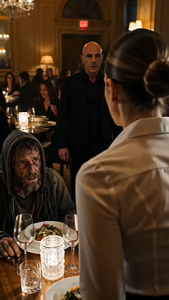
Mia crossed her arms. “I highly doubt that.”
A few customers turned to watch. One man shook his head. A woman frowned. The homeless man reached slowly into his pocket and pulled out a few crumpled bills and coins.
“I have money,” he said quietly.
Mia laughed under her breath. “Enough for what? Don’t waste my time.”
The man’s jaw tightened, but he stayed calm. “Just a bowl of soup and water, please.”
“No,” Mia said, louder now. “You can leave before I call security.”
The room went quiet. The man looked around, humiliated. “I’m not here to cause trouble.”
“And I’m not here to clean up your mess,” Mia snapped.
That’s when a voice came from the back booth.
“Excuse me, can I ask why you’re speaking to him like that?”
Everyone turned. A man in a dark coat stood up from the corner booth. He had been sitting there unnoticed for the past twenty minutes. Mia’s confidence faded for the first time.
“He looks suspicious,” she said. “I’m protecting my customers.”
The man walked forward, calm but firm. “From what? A hungry man?”
Mia swallowed. “He doesn’t look like he can pay.”
The man reached into his coat, pulled out a leather wallet, and placed a gold business card on the counter.
“I own this restaurant chain,” he said. “And that man is my brother.”
Mia’s face drained of color.
The homeless man exhaled slowly. “I told you I could pay.”
The owner turned back to Mia. “Do you know why I came here tonight? I wanted to see how staff treat people who don’t look important.”
Mia stammered, “I—I didn’t know…”
“That’s the problem,” he said coldly. “You made a judgment before you made a choice.”
The brother looked down at his hands. “I lost everything last year. My job, my apartment, my wife. But I’m still a person.”
The owner nodded. “And that’s all anyone needs to be treated like.”
Mia looked ashamed now, not angry. “I’m sorry,” she whispered.
The owner didn’t smile. “Sorry is easy. Respect is what matters.”
He motioned to a nearby table. “Bring him soup. A real meal. And bring me the manager.”
For the first time all night, Mia moved without attitude. She served the man herself, hands shaking. He thanked her anyway, which made her feel even worse.
By the end of the night, the restaurant had gotten quiet, but Mia couldn’t stop thinking about what happened. She realized she had judged a man’s worth by his clothes instead of his heart.
Moral: Never confuse someone’s circumstances with their value, because dignity should never depend on appearance.