




A Man Bought Her Bread Once… Years Later, Five Black Cars Stopped Outside His Stall 😨

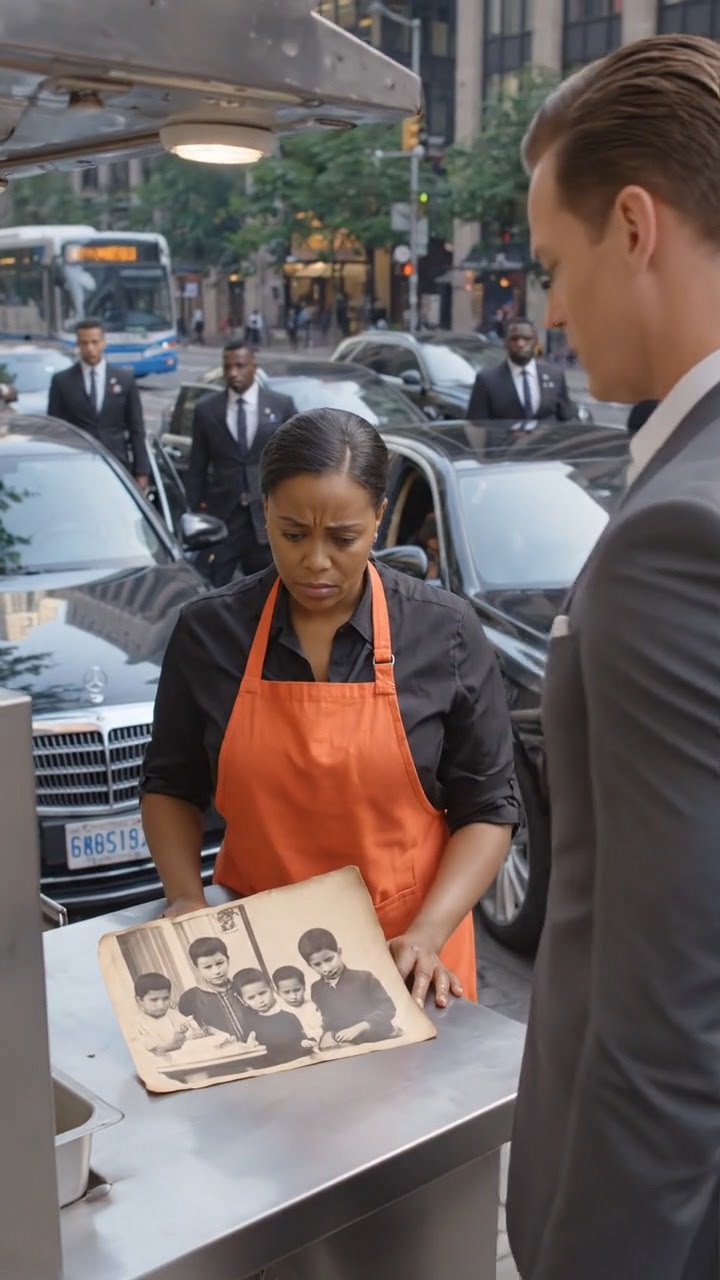
The street carried its usual rhythm—quiet, steady, and familiar. Vendors called out softly, not to attract attention but to remind people they were there. Metal trays clinked, oil whispered in shallow pans, and the scent of bread and roasted meat lingered in the air. It wasn’t a wealthy street, but it was alive in its own way. It survived, just like the people who worked there.
Amara stood behind her small wooden stall, folding flatbread with practiced ease. Her hands moved without hesitation, shaped by years of repetition. A faint line of flour marked her wrist, and a burn scar near her thumb had long since become part of her routine. She didn’t rush. People like her didn’t rush—they endured.
Everything about her day followed a pattern. The same customers, the same motions, the same quiet exchanges. Nothing unexpected ever lasted long in a place like this.
Until something changed.
At first, it was just a sound—subtle, almost unnoticeable, yet completely out of place. The smooth hum of an engine, too refined for a street where vehicles usually struggled before settling into motion. Then another followed. And then more.
Five identical black vehicles slowly entered the narrow street, moving with a kind of quiet precision that didn’t belong there. Conversations didn’t stop, but they faded. People didn’t stare openly, yet their attention shifted.
Amara didn’t look up immediately. She finished folding the bread in her hand, placed it neatly aside, and only then raised her eyes.
The cars had already stopped.
Their doors opened one by one, not dramatically, but with a calm, deliberate rhythm. The people who stepped out carried themselves differently—not hurried, not curious, but composed. They didn’t glance at the surroundings or acknowledge the street. Their attention was already fixed.
On her.
Amara’s hands stilled, just slightly. Something old, something she had buried beneath years of routine, stirred quietly within her.
The first man approached, his coat structured and clean in a way that suggested intention rather than display. Others followed behind him—a woman, two more men, and another who seemed to observe everything without appearing to. They stopped in front of her stall, close enough to speak but distant enough to remain strangers.
By now, the street had fallen into a kind of silence that didn’t need to be announced.
Amara wiped her hands on her apron—not because they were dirty, but because she needed something to anchor herself.
“Yes?” she said simply.
The man in front of her didn’t respond immediately. His eyes moved slowly—over the bread, the stall, her hands—and then finally settled on her face. Recognition didn’t appear at once, but something else did: the quiet effort of memory searching for form.
“You used to stand here at night,” he said at last.
Amara’s expression tightened slightly. “I still do.”
There was a brief pause, measured and deliberate.
“You gave food away,” he continued.
It wasn’t an accusation. It wasn’t praise. It was simply a fact, returned to its place.
Amara’s fingers curled gently against the edge of the stall. “That was a long time ago,” she replied.
The woman stepped forward then, her voice softer but no less steady. “You didn’t ask names,” she said. “You didn’t ask questions.”
And just like that, the past returned.
Cold nights. Three small figures near the corner. Too young to be alone, too quiet to ask for help.
“I didn’t have much,” Amara said. It wasn’t a defense. It was the truth.
The man nodded. “We know.”
He reached into his coat and carefully placed something on the metal surface between them. Amara looked down.
A photograph.
Old, slightly faded. Three children sitting on the pavement, holding pieces of bread. And behind them—her. Younger, tired, but smiling.
Her breath caught.
Then she noticed something else beneath it—a document, thicker, official. Her name was printed clearly across the top.
She didn’t touch it at first.
“What is this?” she asked quietly.
The man met her gaze, his expression steady—not emotional, not dramatic, but complete.
“You fed us when we were invisible,” he said.
The words didn’t rise. They settled.
“And we said… if we ever became visible…”
He paused, not for effect, but because the moment demanded it.
“…we would come back.”
The street seemed to disappear. The sounds, the cold air, the passing people—none of it mattered anymore. Everything that had once felt small now carried weight.
Amara finally reached for the document. Her hands weren’t shaking, but they weren’t steady either. She read it once. Then again.
Ownership.
Transfer.
Her name.
Her future—changed.
She looked up, not overwhelmed, not confused, just quiet.
“Why?” she asked.
This time, the woman answered.
“Because you didn’t wait to have enough,” she said gently. “You gave anyway.”
Silence returned.
But it wasn’t the same silence.
This one held something different.
And for the first time in years, Amara didn’t feel like she was simply surviving.
She felt seen.